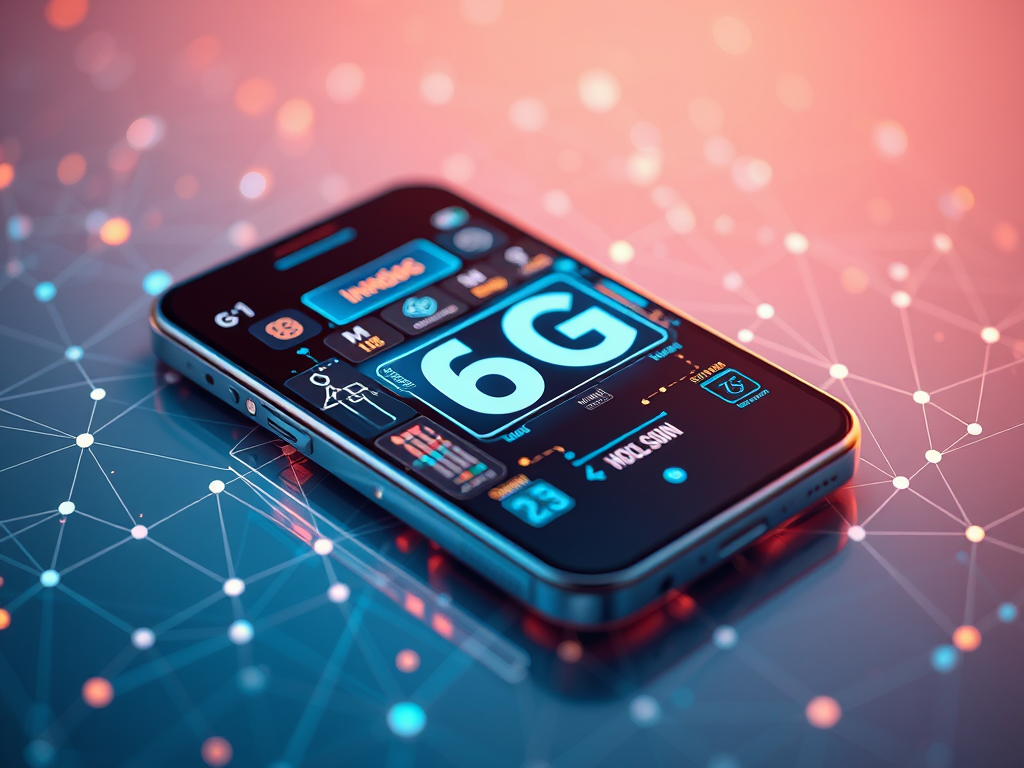
The transition from 5G to 6G represents more than just an increase in bars on a smartphone. It marks the shift from a network that connects “everyone and everything” to one that creates a seamless bridge between the physical and digital worlds.
As of 2026, while 5G is the global standard for high-performance connectivity, the industry has officially moved into the formal standardization phase for 6G, with early prototype testing currently underway.
1. 5G: The Foundation of Today
5G (Fifth Generation) was designed to solve the limitations of 4G by introducing massive capacity and ultra-reliable low-latency communication (URLLC). It operates on three distinct frequency tiers: Low-band (for coverage), Mid-band (the sweet spot for speed and range), and High-band/mmWave (for extreme speeds in dense areas).
Key Capabilities of 5G
- Peak Speeds: Up to 20 Gbps (theoretical).
- Latency: Reduced to approximately 1–5 milliseconds.
- Connection Density: Supports 1 million devices per square kilometer.
- Primary Use Cases: Fixed Wireless Access (FWA), 4K video streaming, and the initial wave of industrial IoT (IIoT).
2. 6G: The “Internet of Everything”

While 5G is revolutionary, 6G is anticipated to be evolutionary. Targeted for commercial rollout around 2030, 6G will move beyond traditional radio frequencies into the Terahertz (THz) band. This allows for data transmission at speeds that were previously only possible via fiber-optic cables.
What Makes 6G Different?
- AI-Native Design: Unlike 5G, where AI is an add-on, 6G is built with AI at its core to manage network traffic, predict outages, and optimize energy consumption in real-time.
- Terahertz Spectrum: Operating between 100 GHz and 3 THz, 6G provides massive bandwidth, though it requires new materials and “reconfigurable intelligent surfaces” to help signals bounce around obstacles.
- Integrated Sensing: 6G networks will act like a giant radar, sensing the position, shape, and movement of objects in the environment without needing a separate camera or sensor.
3. Comparison: 5G vs. 6G
The following table highlights the technical leaps expected as we move toward the 6G era.
| Feature | 5G (Current Standard) | 6G (Expected 2030+) |
| Peak Data Rate | 20 Gbps | 1 Tbps (1,000 Gbps) |
| Latency | 1–5 ms | < 100 microseconds |
| Spectrum | Sub-6 GHz, mmWave | Sub-THz to Terahertz |
| Reliability | 99.999% | 99.99999% |
| Coverage | Terrestrial (Ground-based) | Global (Space-Air-Ground-Sea) |
| Architecture | Massive MIMO | Cell-Free / Distributed AI |
4. Future Use Cases
The jump from 1ms to 100 microseconds of latency opens doors to technologies that seem like science fiction today:
- Holographic Communication: Real-time, high-fidelity 3D holograms for remote meetings and education.
- Tactile Internet: Feeling textures or resistance through a remote interface, enabling surgeons to perform operations from another continent with “touch” feedback.
- Bio-Digital Integration: Connectivity for advanced medical implants and Brain-Computer Interfaces (BCI).
- Autonomous Swarms: Perfect coordination of thousands of autonomous drones or vehicles in 3D space (including air and sea).
5. Challenges on the Horizon
The road to 6G isn’t without hurdles. The Terahertz frequencies have extremely short range and are easily blocked by walls, rain, or even human hands. Furthermore, the energy cost of processing terabits of data per second requires a massive breakthrough in “Green 6G” technologies to ensure the network doesn’t become a climate liability.
As we stand in 2026, the focus is on Release 19 and 20 of the global standards, which act as the bridge between the 5G we use today and the 6G world of tomorrow.
To understand where we are headed with 6G, we have to look back at the “G” family tree. Each generation has been defined by a specific shift in how we communicate—moving from simple voice calls to a world where even your toaster is online.
The Evolution of Connectivity: A Brief History
1G: The Analog Era (1980s)
The first generation was all about mobility. Before 1G, “mobile” phones were usually tethered to cars. Launched commercially by NTT in Japan (1979) and Ameritech in the US (1983), 1G used analog signals.
- The Experience: Voice only, poor battery life, and zero security (anyone with a radio scanner could eavesdrop on your call).
- Speed: A “blazing” 2.4 kbps.
2G: The Digital Shift (1990s)
The introduction of Global System for Mobile Communications (GSM) changed everything. By switching from analog to digital, 2G allowed for encryption and, most importantly, the SMS (Short Message Service).
- The Experience: Texting became a cultural phenomenon. We also saw the birth of basic data services like GPRS.
- Speed: Up to 50 kbps (later reaching 384 kbps with EDGE).
3G: The Birth of the Mobile Web (2000s)
3G brought the “Internet” to our pockets. It used packet switching rather than circuit switching, allowing for the first wave of smartphones.
- The Experience: Mobile web browsing, GPS, and very choppy video calling. This was the era where the BlackBerry and the original iPhone redefined the “phone.”
- Speed: Averaged 2 Mbps.
4G LTE: The App Economy (2010s)
4G (Long Term Evolution) was a total overhaul of the network architecture. It was designed specifically for high-speed data.
- The Experience: This generation gave birth to the Gig Economy. Without 4G, services like Uber, Netflix streaming, and Instagram wouldn’t have been possible. It made high-definition video on the go a reality.
- Speed: Targeted 100 Mbps to 1 Gbps.
5G: The Industrial Pivot (2020s)
While previous generations focused on connecting people, 5G was built to connect machines. Launched around 2019, it introduced “Network Slicing,” allowing a single physical network to be carved into virtual networks for different uses (like one slice for emergency services and another for gaming).
- The Experience: Zero-lag gaming, smart cities, and the massive expansion of IoT.
Timeline of Innovation
| Generation | Era | Primary Service | Key Technology |
| 1G | 1980s | Analog Voice | AMPS / TACS |
| 2G | 1990s | Digital Voice & SMS | GSM / CDMA |
| 3G | 2000s | Mobile Data | UMTS / WCDMA |
| 4G | 2010s | High-Speed Mobile Web | LTE / WiMAX |
| 5G | 2020s | Critical IoT & Massive Speed | NR (New Radio) |
| 6G | 2030 (est) | Bio-Digital Sensing | Terahertz (THz) |
Why the 10-Year Cycle?
You might notice a pattern: a new “G” arrives roughly every 10 years. This is because it takes a decade to:
- Research the new physics/math required.
- Standardize the tech globally so a phone from Europe works in Asia.
- Deploy the massive physical infrastructure (towers and fiber) needed to run it.




Leave a Reply