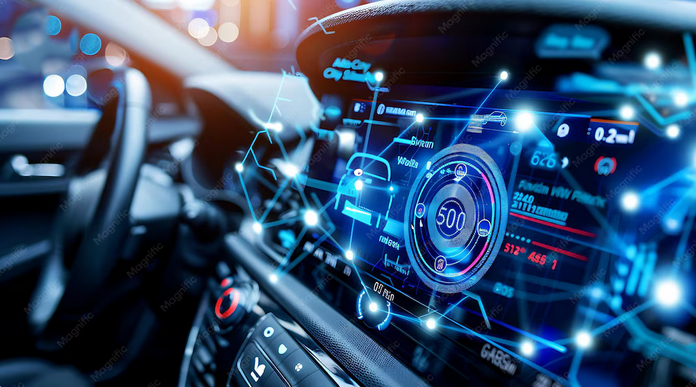
This comprehensive exploration details the five pillars of modern automotive technology: the rise of agentic AI, the breakthrough in solid-state energy, the infrastructure of V2X, the democratization of autonomy, and the architecture of the digital cockpit.
1. The Brain of the Machine: Software-Defined Architecture
In 2026, the value of a vehicle is determined more by its code than its cylinders. The shift to Software-Defined Vehicles (SDVs) has fundamentally decoupled hardware from software, allowing manufacturers to update a car’s performance, safety, and features throughout its lifecycle.
Zonal Computing and Centralization
Historically, cars were a mess of “Electronic Control Units” (ECUs)—dozens of tiny computers responsible for single tasks like rolling down a window or managing fuel injection. Today, we use Zonal Architecture.
- The Concept: High-performance central computers act as the brain, while zonal gateways manage sensors and actuators in specific areas of the car.
- The Benefit: This reduces wiring weight by up to 30% and allows for massive data throughput.
- Continuous Innovation: Platforms like Stellantis’s STLA Brain and Mercedes-Benz’s MB.OS allow for Over-the-Air (OTA) updates. A car bought in 2026 can receive a software patch in 2027 that improves its braking distance or adds a new autonomous highway pilot mode.
Monetization and “Feature-as-a-Service”
This architecture has birthed a new business model. Automakers are now software providers. Drivers can subscribe to heated seats for the winter months, pay for a temporary horsepower boost for a road trip, or trial advanced parking assistants for a small monthly fee.
2. Energy Revolution: Beyond Standard Lithium-Ion
The “range anxiety” of the early 2020s has been largely quelled by 2026, thanks to a two-pronged advancement in battery chemistry: the commercialization of Semi-Solid State Batteries and Silicon Anodes.
Semi-Solid State Dominance
While all-solid-state batteries (ASSBs) are still in pilot phases, semi-solid state technology is now in mass production.
- The Breakthrough: By using a hybrid of solid and liquid electrolytes, these batteries achieve an energy density of 350–500 Wh/kg.
- Real-World Impact: Manufacturers like NIO are now deploying 150 kWh packs that offer over 930 km (577 miles) of range. These cells are inherently safer, as the reduced liquid content makes them far less susceptible to thermal runaway (fires).
The Silicon Anode Leap
For more affordable EVs, the shift from graphite to Silicon-dominant anodes has been the game-changer.
- Capacity: Silicon can hold up to ten times more lithium ions than graphite.
- Charging Speeds: In 2026, 800-volt architectures combined with silicon anodes allow for “extreme fast charging” (XFC), capable of adding 150 km of range in under five minutes, bringing the charging experience closer to the time it takes to pump gasoline.
3. The Digital Cockpit: Agentic AI and the Human-Machine Interface
The dashboard has evolved from a tool for information into a proactive AI Co-Pilot. In 2026, generic voice assistants have been replaced by Large Language Models (LLMs) specifically trained on automotive data.
Predictive Intelligence
Modern assistants, such as those integrated by BMW (via Alexa+ architecture) and Mercedes-Benz, are no longer reactive. They are context-aware.
- Multi-Intent Processing: You can say, “I’m running late for my meeting; find the fastest route, notify my team via email, and suggest a place to grab a quick protein bar on the way,” and the AI handles all three tasks simultaneously.
- In-Cabin Sensing: AI-driven cameras monitor driver fatigue, heart rate, and stress levels. If the system detects a drop in alertness, it can automatically adjust the climate control, tighten the seatbelt for a haptic “nudge,” or suggest a nearby rest stop.
Immersive HUDs
2026 marks the widespread adoption of Augmented Reality Head-Up Displays (AR-HUDs). Instead of looking down at a screen, navigation cues are projected directly onto the windshield, appearing as if they are painted onto the asphalt. These systems can highlight pedestrians in low light or show a virtual “follow-me” car to guide drivers through complex interchanges.
4. V2X: The Internet of Moving Things
Vehicle-to-Everything (V2X) is the invisible infrastructure that makes the cities of 2026 function. Utilizing high-speed 5G-enabled C-V2X (Cellular V2X), cars are in a constant state of “conversation” with their environment.
| Connection Type | Practical 2026 Application |
| V2I (Infrastructure) | Traffic lights communicate timing to vehicles, allowing “Green Light Optimized Speed Advisory” to reduce idling. |
| V2V (Vehicle) | If a car three vehicles ahead slams on its brakes, your car receives a signal and prepares for emergency braking before you even see the brake lights. |
| V2P (Pedestrian) | Alerts drivers to the presence of pedestrians or cyclists hidden behind blind corners by detecting their smartphone signals. |
| V2G (Grid) | EVs act as a distributed battery for the city, selling power back to the grid during peak hours to stabilize energy costs. |
5. Autonomy and ADAS: The “Level 3” Reality
While the dream of “Level 5” (full autonomy everywhere) remains a distant goal, 2026 has seen the standardization of SAE Level 3 Autonomy in premium and even mid-range segments.
Hands-Off, Eyes-Off
On approved motorways, systems like Mercedes-Benz DRIVE PILOT or Waymo’s updated city fleet allow drivers to legally disengage from the task of driving. Under specific conditions—typically up to 95 km/h (60 mph) on divided highways—the car assumes full legal responsibility for the journey.
Sensor Fusion: LiDAR and 4D Imaging Radar
The reliability of these systems is built on Sensor Fusion.
- LiDAR: Laser-based 3D mapping has become affordable enough for mass-market cars, providing precise distance measurements even in total darkness.
- 4D Radar: Unlike traditional radar, 4D imaging radar can detect the height of objects, distinguishing between a discarded tire on the road and an overhead bridge, drastically reducing “phantom braking” incidents.
Conclusion: The New Definition of Mobility
By 2026, technology has transformed the automobile into something far more than a transportation device. It is a sophisticated node in a global digital network. The integration of Agentic AI has made the car a personal assistant; Solid-State technology has made it a mobile power plant; and V2X connectivity has made it a proactive guardian of public safety.
As we look toward the end of the decade, the focus of innovation will likely move from how the car moves to what the driver does with their newfound time. In the tech-heavy automotive world of 2026, the ultimate luxury isn’t the leather on the seats—it’s the intelligence of the machine.