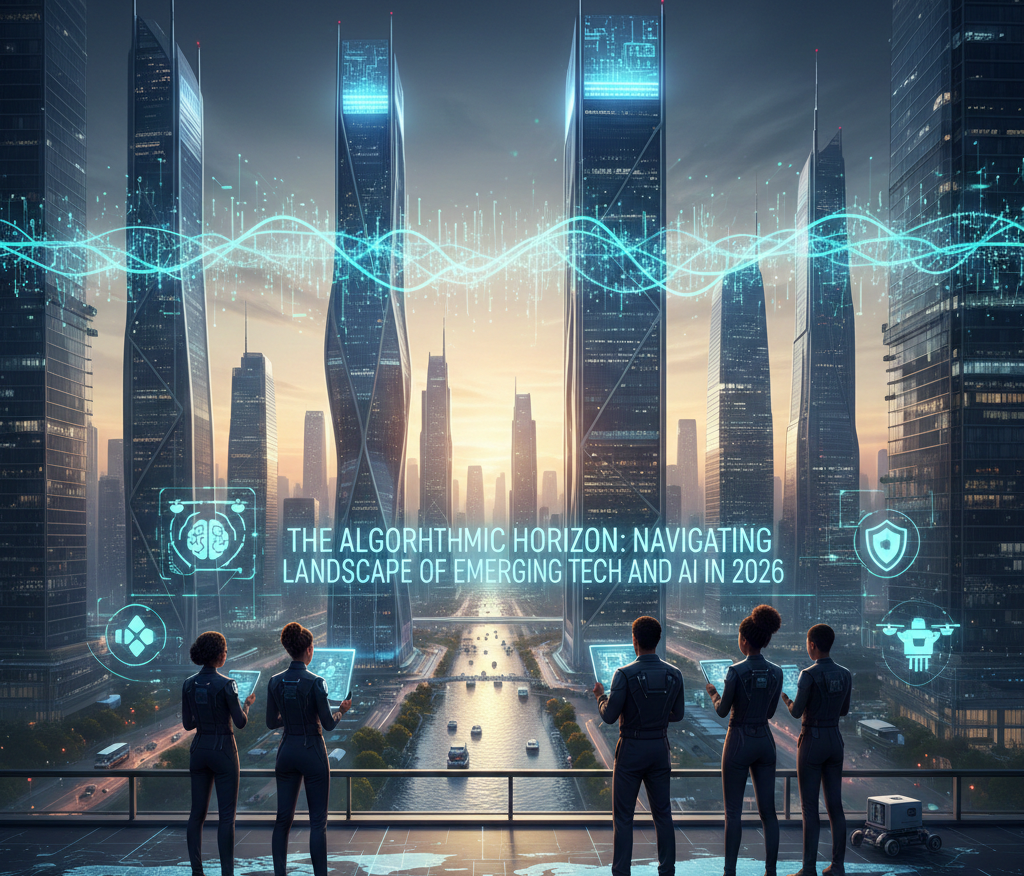
The year 2026 dawns upon a world irrevocably shaped by technology, a landscape where the lines between science fiction and everyday reality continue to blur at an astonishing pace. At the heart of this transformation lies the symbiotic evolution of emerging technologies and Artificial Intelligence (AI). AI, once a niche concept explored in academic labs and Hollywood thrillers, has permeated nearly every facet of human existence, not as a standalone entity, but as the invisible intelligence powering the next generation of innovations.
This article delves into the most impactful emerging technologies of 2026, examining how AI acts as their accelerant, interpreter, and orchestrator. We will explore the societal implications, ethical quandaries, and the boundless opportunities these advancements present, painting a comprehensive picture of our rapidly evolving digital frontier.
The Rise of Ambient AI: Intelligence Everywhere, Yet Nowhere
One of the most profound shifts in AI’s evolution is its transition from explicit interaction to ambient presence. In 2026, AI is less about talking to a smart speaker and more about a pervasive, anticipatory intelligence embedded in our environments.
Smart Cities and Infrastructures: AI-powered sensors and predictive algorithms now manage urban traffic flows with unprecedented efficiency, dynamically adjusting light timings, rerouting vehicles around accidents, and even predicting congestion before it occurs. Waste management systems utilize AI to optimize collection routes, reducing fuel consumption and emissions. Energy grids, once static, are now AI-optimized, predicting demand fluctuations and intelligently distributing renewable energy sources. This ambient intelligence monitors, learns, and adapts, making urban living smoother and more sustainable.
Hyper-Personalized Environments: Imagine walking into your office or home, and the lighting, temperature, and even the background music subtly adjust to your known preferences, dictated not by manual input, but by AI learning your historical patterns and real-time biometric data. In retail, AI-driven digital signage offers personalized promotions as you browse, while augmented reality (AR) mirrors allow you to virtually try on clothes, with AI predicting the best fit and style based on your body scan and fashion history. This level of personalization, while convenient, also raises significant questions about data privacy and the potential for a “filter bubble” effect, where individuals are increasingly exposed only to information and experiences that confirm their existing biases.
Healthcare’s Predictive Leap: Ambient AI in healthcare is revolutionizing patient care. Wearable devices, far more sophisticated than their 2020 counterparts, continuously monitor vital signs, sleep patterns, and activity levels, feeding data into AI models that can detect subtle precursors to illness long before symptoms manifest. These systems alert patients and their doctors to potential issues, facilitating proactive intervention. Hospitals utilize AI for predictive maintenance of critical equipment, optimizing patient flow, and even assisting in surgical procedures by providing real-time data analysis and guidance.
The Immersive Internet: Beyond Screens and Into Worlds
The internet of 2026 is no longer confined to flat screens. It’s an immersive, multi-sensory experience, driven by advancements in spatial computing and AI-powered content generation.
The Metaverse Maturation: While the initial hype of the metaverse has settled into more practical applications, its potential is undeniable. AI plays a critical role in generating vast, persistent virtual worlds, populating them with intelligent non-player characters (NPCs) that exhibit realistic behaviors, and facilitating seamless interaction between users. From collaborative workspaces where teams meet as photorealistic avatars to hyper-realistic gaming environments and virtual tourism experiences, the metaverse is evolving into a rich digital layer intertwined with reality.
Augmented Reality (AR) as the New Interface: AR headsets, now sleek, lightweight, and boasting vastly improved fields of view and battery life, are becoming as commonplace as smartphones once were. AI-powered AR overlays information onto the real world in real-time. Imagine a mechanic seeing holographic repair instructions superimposed on an engine, a surgeon visualizing patient data during an operation, or a tourist having historical facts and translations instantly appear over landmarks. This “digital twin” of reality, enhanced by AI, blurs the lines between physical and virtual, transforming how we perceive and interact with our surroundings.
Haptic Feedback and Multi-Sensory Experiences: The immersive internet isn’t just visual and auditory. Advanced haptic technologies, often integrated with AI to fine-tune sensations, allow users to “feel” digital objects and environments. This ranges from realistic texture feedback in VR gloves to full-body suits that simulate impacts or temperature changes. AI analyzes the virtual environment and translates it into appropriate tactile sensations, deepening the sense of presence and realism.
AI’s Creative Renaissance: Art, Design, and Content Generation
Perhaps one of the most surprising and controversial areas of AI advancement is its burgeoning role in creative fields. In 2026, AI is not merely a tool for artists and designers; it is a co-creator, capable of generating original works with astonishing speed and complexity.
Generative AI in Art and Music: Large Language Models (LLMs) and Diffusion Models have evolved to produce breathtaking visual art, compose intricate musical pieces, and even write compelling poetry and prose. These AIs are trained on vast datasets of existing human creations, learning patterns, styles, and themes, which they then remix and synthesize into novel outputs. This raises profound questions about authorship, copyright, and the very definition of creativity. Is AI art truly “art,” and who owns the intellectual property?
AI in Design and Architecture: Architects use AI to rapidly generate myriad design variations based on parameters like structural integrity, material costs, energy efficiency, and aesthetic preferences. Product designers leverage AI to optimize ergonomics and manufacturing processes. Even fashion designers employ AI to predict trends and generate new apparel designs, streamlining the creative workflow from concept to prototype.
Personalized Content Creation: Media companies and individual content creators utilize AI to generate personalized news summaries, tailor marketing campaigns to individual preferences, and even create entire video segments using AI-generated avatars and voiceovers. This allows for hyper-targeted content delivery, but also fuels concerns about the spread of misinformation and the erosion of journalistic integrity if not managed responsibly.
Quantum Computing: The AI-Accelerating Superpower on the Horizon
While still largely in the research and development phase, Quantum Computing in 2026 represents the ultimate emerging technology, promising to unlock computational power orders of magnitude beyond even the most powerful supercomputers. Its relevance to AI is profound.
Solving Unsolvable Problems: Quantum computers, when they reach practical scalability, will revolutionize AI’s ability to tackle complex problems. Imagine AI models capable of simulating entire biological systems to discover new drugs, optimizing global supply chains in real-time, or performing financial modeling with unprecedented accuracy.
Advanced Machine Learning: Quantum algorithms could dramatically accelerate the training of deep learning models, enabling AIs to learn from smaller datasets, identify more subtle patterns, and develop more sophisticated forms of intelligence. This includes breakthroughs in areas like quantum machine learning for materials science or drug discovery.
Cryptographic Revolution: On the flip side, quantum computing also poses a significant threat to current encryption standards. The development of quantum-resistant cryptography (post-quantum cryptography) is a critical emerging field, with AI playing a role in designing and validating these new, more robust security protocols.
Ethical Quandaries and Societal Shifts
The rapid deployment of these emerging technologies and the pervasive influence of AI are not without their complexities. As we push the boundaries of innovation, critical ethical, social, and economic questions demand our attention.
The Future of Work: While AI and automation are creating new jobs in areas like AI development, data science, and AI ethics, they are simultaneously displacing roles that involve repetitive tasks. The challenge lies in retraining the workforce and fostering a culture of lifelong learning to adapt to these shifts. The concept of Universal Basic Income (UBI) is gaining more serious consideration as a potential social safety net in an increasingly automated economy.
Bias and Fairness in AI: AI systems are only as unbiased as the data they are trained on. If historical data reflects societal biases (e.g., racial, gender), the AI will perpetuate and even amplify those biases. Addressing this requires diverse datasets, transparent AI models, and rigorous ethical audits. The development of “explainable AI” (XAI) is crucial, allowing humans to understand how AI makes decisions, thereby identifying and mitigating potential biases.
Privacy and Data Sovereignty: The ambient nature of AI means more data than ever is being collected about individuals. Ensuring robust data privacy laws, empowering individuals with control over their personal data, and establishing clear ethical guidelines for data usage are paramount. Concepts like “data trusts” and decentralized identity systems are gaining traction to give individuals greater agency.
AI Safety and Control: As AI becomes more autonomous and intelligent, concerns about its safety and alignment with human values grow. Research into “alignment problems,” ensuring AI systems operate within intended parameters and do not develop unintended, potentially harmful objectives, is a critical area. This includes developing robust testing environments, ethical frameworks for AI decision-making, and mechanisms for human oversight and intervention.
Digital Divide: The benefits of emerging tech and AI are not evenly distributed. A significant risk is the widening of the digital divide, where access to these transformative technologies becomes a privilege rather than a universal right. Bridging this gap requires concerted efforts in digital literacy, affordable access to technology, and inclusive policy-making.
The Path Forward: A Call for Responsible Innovation
The year 2026 represents a pivotal moment in human history, where the seeds of unprecedented technological advancement are blossoming into transformative realities. The symbiotic relationship between emerging technologies and AI is creating a world of augmented intelligence, immersive experiences, and predictive power.
To navigate this algorithmic horizon successfully, we must embrace responsible innovation. This means:
- Prioritizing Ethical Design: Embedding ethical considerations from the very inception of AI systems and emerging technologies.
- Fostering Transparency and Explainability: Demystifying AI’s decision-making processes and making its impacts understandable.
- Promoting Inclusivity and Accessibility: Ensuring that the benefits of these technologies are accessible to all, regardless of socio-economic status or geographical location.
- Investing in Education and Retraining: Preparing society for the evolving nature of work and the skills required in an AI-driven economy.
- Encouraging Global Collaboration: Addressing complex challenges like AI safety and data governance through international cooperation.
The algorithmic horizon is not a distant future; it is our present. By approaching this era with foresight, critical thinking, and a commitment to human well-being, we can harness the immense power of emerging tech and AI to build a more intelligent, equitable, and sustainable world for all. The journey has just begun, and its direction will be shaped by the choices we make today.